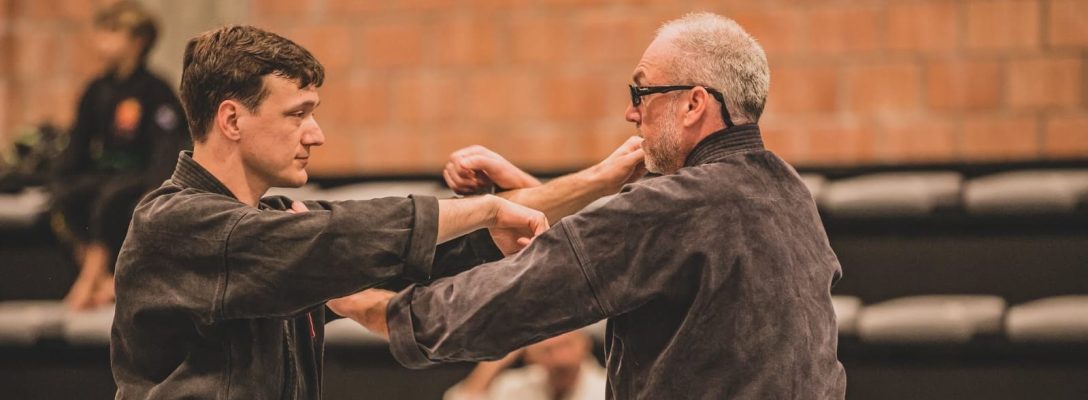
Kote-gaeshi
The supinating wristlock (referred to as kote gaeshi, “forearm return”) is a rotational wristlock, and arguably the most common wristlock. It involves rotating the hand so that it becomes maximally supinated, often referred to as ‘externally rotating’ the wrist, and hence putting a joint lock on the wrist and radioulnar joint. This can be done by grabbing the opponent’s hand with one or both hands, and twisting the hand so that the opponent’s thumb points away from the opponent. A supinating wristlock performed from a stand-up position can be used to force the opponent to the ground on his or her back. Kote-gaeshi is used in beginning of the locking set that we get from Kosho.


Kote-mawashi
The pronating wristlock (referred to as kote mawashi, “forearm turn”) is similar to the supinating wristlock except that it is reversed in direction, known as ‘internally rotating’ the wrist. The hand becomes maximally pronated, resulting in a joint lock on the wrist and radioulnar joint. The degree of possible pronation depends on the degree of flexion at the elbow, as a bent elbow inhibits rotation of the humerus. Hence, straightening the arm allows rotation of the whole arm and alleviates the pressure on the joints. The arm has to be additionally twisted until the shoulder joint reaches maximal rotation to preserve the joint lock. This typically results in the arm moving posteriorly, and allows for the complementary technique of pushing the arm at the elbow or shoulder to force the opponent to the ground.

Kote-mawashi is the lock created by rotating the opponent’s hand in the other direction. It is often coupled with an arm bar over the elbow, and is the beginning of the locking set that we get from Kali.